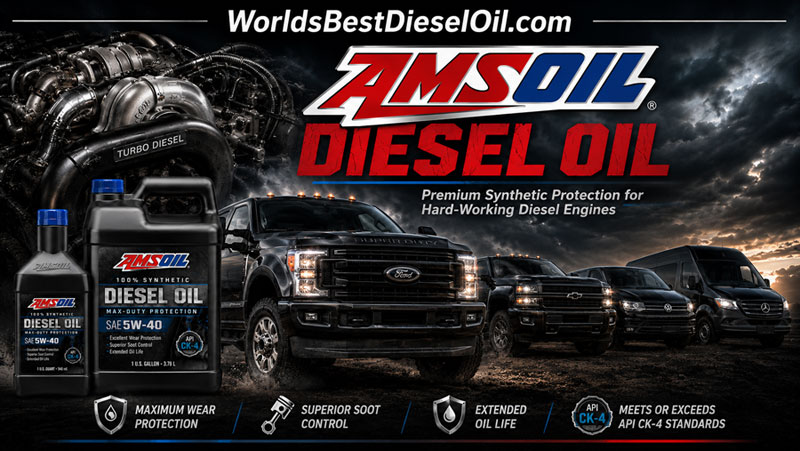
For the 1983 GMC Jimmy with the 6.2L 8-cylinder Diesel engine (Code C), the oil capacity is 7 quarts with a filter change. SAE 10W-30 is the preferred viscosity for temperatures above -18°C, though various options exist depending on ambient conditions. AMSOIL recommends using Signature Series 10W-30 100% Synthetic Max-Duty Diesel Oil (DTTQT-EA) paired with an AMSOIL Oil Filter (EAO24-EA) for optimal protection.
What oil does a 1983 GMC Jimmy 6.2L Diesel take?
The 1983 GMC Jimmy 6.2L diesel requires an oil with the CF-4 specification. Viscosity selection should be based on your operating temperature: SAE 10W-30 is preferred for temperatures above -18°C, while 5W-30 is recommended for environments below 16°C. Other options include 15W-40 (above -12°C) and higher viscosities like 20W-50 for warmer climates.
AMSOIL product recommendations
Based on the AMSOIL lookup for your 1983 GMC Jimmy 6.2L Diesel, the following products are recommended to maintain engine and component health.
Engine Oil Options
| Product Name | Code |
|---|---|
| AMSOIL Signature Series 10W-30 100% Synthetic Max-Duty Diesel Oil | DTTQT-EA |
| AMSOIL 10W-30 Heavy-Duty 100% Synthetic Diesel Oil | ADNQT-EA |
| AMSOIL Signature Series 5W-30 100% Synthetic Max-Duty Diesel Oil | DHDQT-EA |
Oil Filter Options
Coolant & Transmission Fluids
| Product Name | Code |
|---|---|
| AMSOIL Passenger Car & Light Truck Antifreeze & Coolant | ANTPC1G-EA |
| AMSOIL Propylene Glycol Antifreeze and Engine Coolant | ANT1G-EA |
| AMSOIL Signature Series Fuel-Efficient 100% Synthetic ATF | ATLPK-EA |
| AMSOIL OE Fuel-Efficient 100% Synthetic ATF | OTLQT-EA |
Engine Oil Specifications
| Viscosity Range | Temperature Condition |
|---|---|
| 10W-30, 10W-40 | Above -18°C (10W-30 preferred) |
| 15W-40 | Above -12°C |
| 20W-20, 20W-40, 20W-50 | Above -7°C |
| 30 | Above 4°C |
| 5W-30 | Below 16°C |
Oil Grade: CF-4
Engine Oil Capacity
| Description | Capacity |
|---|---|
| Total capacity with filter | 7 quarts |
Note: Always check the oil level after refilling.
How much oil does it take with a filter change?
A standard oil change for the 6.2L diesel engine in this GMC Jimmy requires 7 quarts of oil when including the replacement of the oil filter. It is critical to verify the oil level manually after the refill process to ensure accuracy.
Automatic Transmission Fluid Specifications
The transmission requirements vary depending on your specific unit (THM700-R4 or THM400). For both, the manufacturer’s technical service bulletin has updated the specification from Dexron II or III to Dexron VI.
THM700-R4 (4 Speed)
| Fill Type | Capacity |
|---|---|
| Total Fill | 11.5 quarts |
| Initial Fill | 5 quarts |
THM400 (3 Speed)
| Fill Type | Capacity |
|---|---|
| Total Fill | 11 quarts |
| Initial Fill | 4.3 quarts |
Diesel maintenance notes for this vehicle
Maintaining a vintage 6.2L diesel requires attention to several key areas:
- Fuel System: Inspect fuel lines and seals regularly to prevent leaks common in older diesel systems.
- Cooling System: Ensure cooling system efficiency is maintained; the coolant capacity for this vehicle is 24.8 quarts.
- Glow Plugs: Verify glow plug functionality for reliable cold starts.
- Chassis Verification: Because 1983 was a transitional year for GM, always verify parts compatibility (filters, gaskets, sensors) against your specific VIN to ensure they match the correct chassis type.
Common diesel oil-related concerns and how AMSOIL products may help
Diesel engines face unique stresses that standard oils may not adequately address.
| Concern | Why it matters | AMSOIL Product | How it may help | Limitation |
|---|---|---|---|---|
| Engine Wear | High pressure in diesel combustion can cause scuffing. | Signature Series 10W-30 | Delivers up to 6X more wear protection. | Requires regular oil changes. |
| Contaminants | Soot and small particles can cause abrasive wear. | AMSOIL Oil Filter | 99% efficiency at 20 microns; greater capacity for small contaminants. | Filter must be replaced per interval. |
| Extreme Temperatures | Viscosity changes can affect lubrication during start-up or heavy load. | Signature Series 5W-30 | Excels in extreme temperatures and maintains proper viscosity. | Not a substitute for mechanical repair. |
Recall, TSB, and manufacturer communication notes
Official NHTSA research indicates the following for the 1983 GMC Jimmy:
- Recall (Campaign 06E026000): Related to exterior lighting. Certain replacement lamps may fail to conform to federal safety standards, potentially resulting in poor illumination.
- Recall (Campaign 83V046000): Related to seats. The inertia lock mechanism may not function, which could allow the seat back or seat to move forward.
Note: These are official records; owners should always verify open recalls by VIN through an authorized dealer.
Common maintenance concerns for this vehicle
- Tire Integrity: NHTSA complaint data has noted reports of tread separation on certain tire models (e.g., Firestone Firehawk ATX). Regular inspections are advised.
- Rubber Components: Given the age of 1980s GM diesel vehicles, inspecting rubber fuel lines and seals is a priority to prevent leaks.
- Cooling System Metals: Using appropriate coolant can help protect all cooling system metals, gaskets, and hoses.
About this vehicle
The 1983 GMC Jimmy represents a transitional period in General Motors’ SUV lineup. During this era, the Jimmy nameplate was utilized for both full-size and compact/mid-size offerings. Historically, the full-size version of the Jimmy was a counterpart to the Chevrolet K5 Blazer, often featuring a removable hardtop. However, it is critical for owners to verify whether this specific vehicle is the full-size variant or the S-series (S-15) compact model, as the latter was introduced in 1983 and shared its architecture with the S-10 Blazer.
The engine specified is a 6.2L 8-cylinder diesel. This engine family is typically associated with utility and heavy-duty applications, making it a candidate for long-term durability if maintained correctly. Because this vehicle sits at the intersection of several model generations (the transition from full-size K-series to S-series), parts compatibility for filters, gaskets, and sensors must be double-checked against the specific VIN to ensure they match the correct chassis type.
Owners of 1980s GM diesel vehicles should focus on fuel system integrity, cooling system efficiency, and glow plug functionality. Because research snippets may not provide direct technical data for every engine code variation (such as Code C), owners should verify exact displacement and compression ratios through official service manuals before performing heavy mechanical work.
Common questions about this vehicle’s diesel oil and maintenance
What is the preferred oil viscosity for my 6.2L Diesel Jimmy?
The AMSOIL lookup suggests SAE 10W-30 is preferred for temperatures above -18°C. For colder climates (below 16°C), 5W-30 is recommended.
How much oil should I buy for an oil change?
Since the capacity is 7 quarts with a filter, purchasing a 5-quart jug and two quart bottles, or a single gallon jug and three quarts, would cover the requirement. AMSOIL offers these in various sizes including Gallon Jugs and 2.5 Gallon Jugs.
Does my transmission need special fluid?
The manufacturer’s technical service bulletin has updated the specification from Dexron II or III to Dexron VI for the THM700-R4 and THM400 transmissions in this vehicle.
Can I extend my oil change intervals?
Products like AMSOIL Signature Series are designed to allow users to confidently extend drain intervals.
What should I check regarding my cooling system?
The coolant capacity is 24.8 quarts. It is important to use a formulation that protects all cooling system metals, gaskets, and hoses, such as the AMSOIL Passenger Car & Light Truck Antifreeze & Coolant.
How do I check for active recalls?
While NHTSA records show historical recalls for lighting and seats, you should always verify current open recalls by using your specific VIN at an authorized dealer or the official NHTSA website.
Disclaimer: This information is derived from provided source data. Always consult your vehicle’s owner manual and official service documentation before performing maintenance.